7 April 2026: Tokyorama, Issue 1
Conversazione: Hiroko Imada Tre Due Monde by Silvia Cardoni
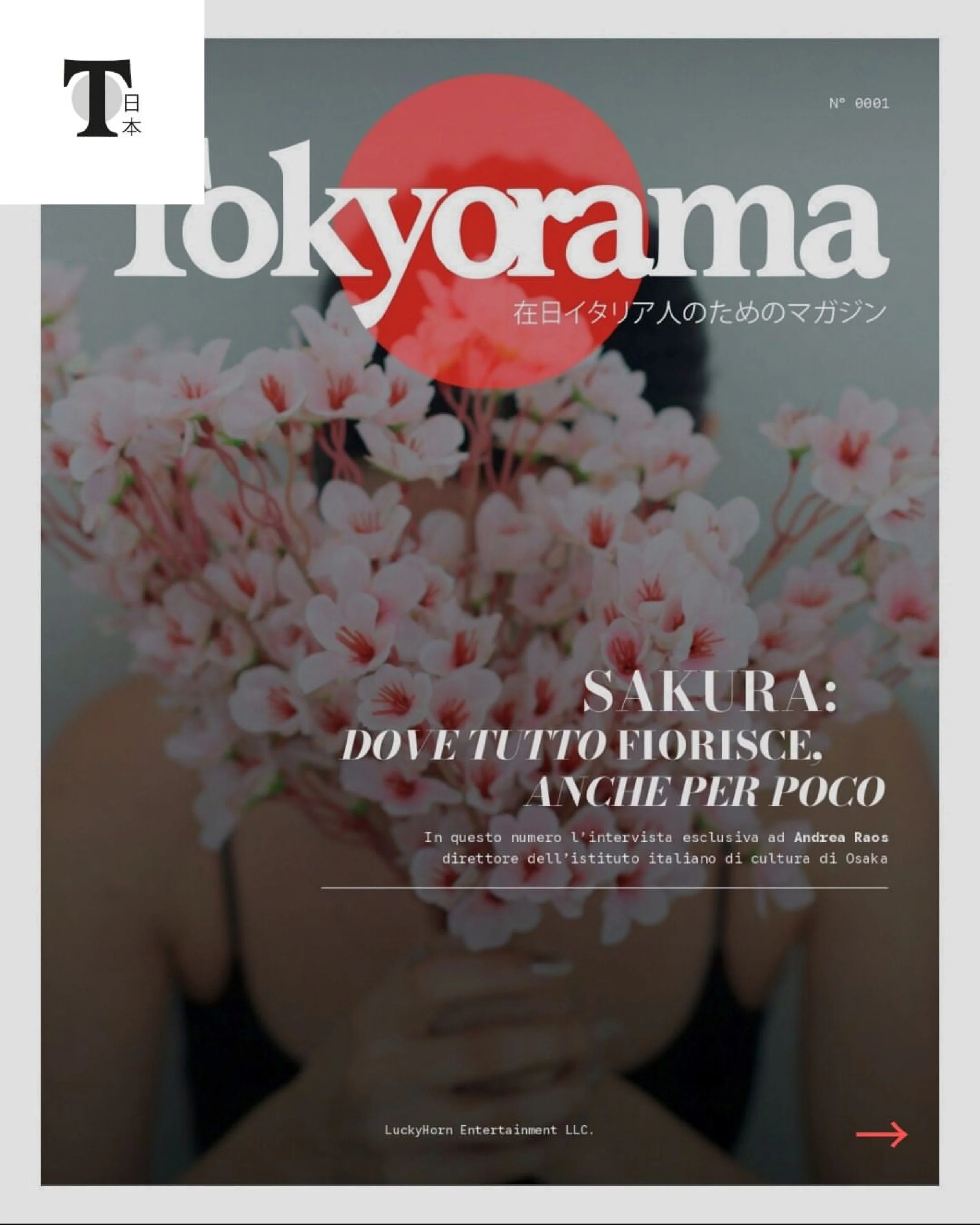
Italian magazine for Italian people living in Japan ‘Tokyorama’ features Hiroko Imada (6 pages interview)
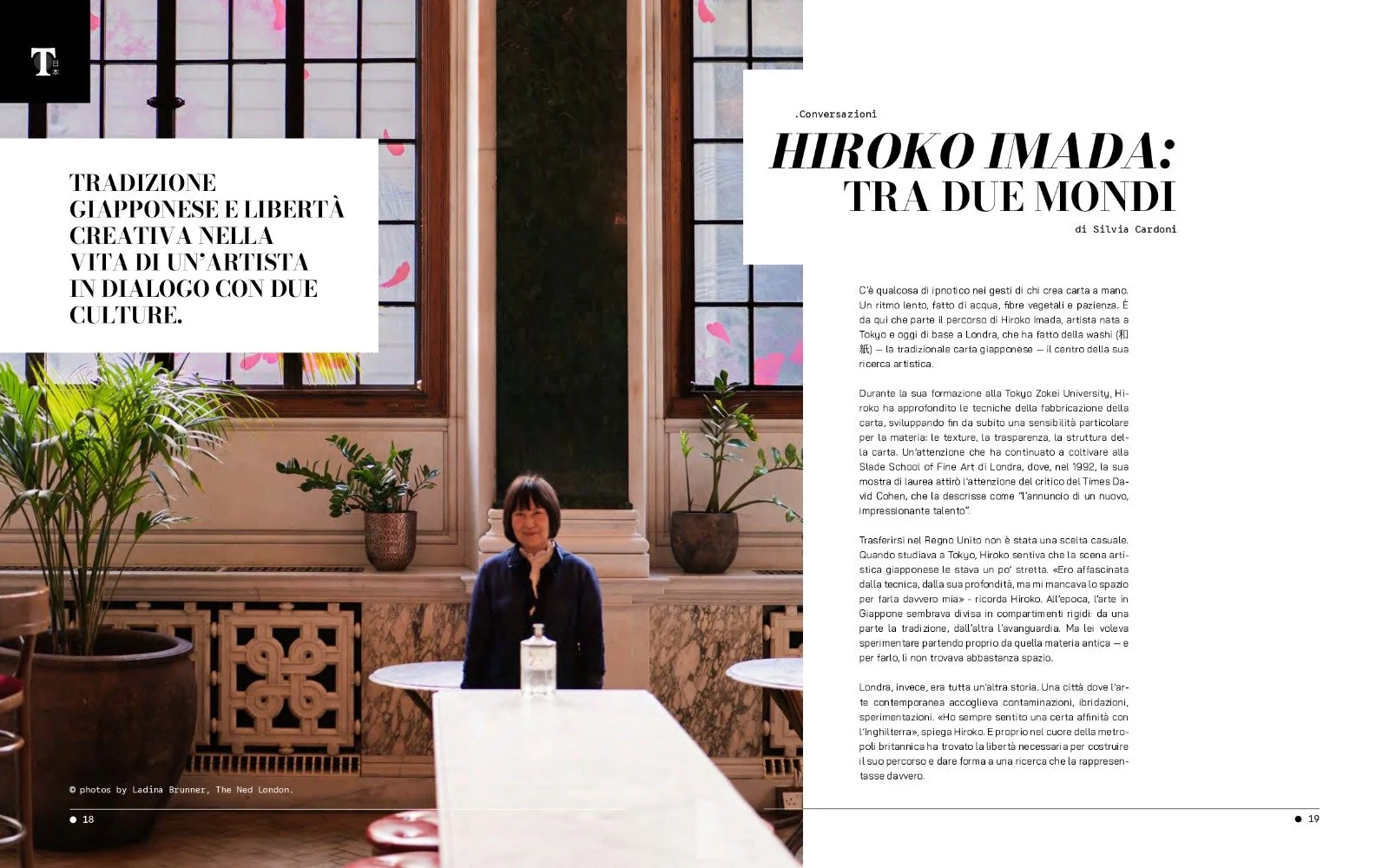
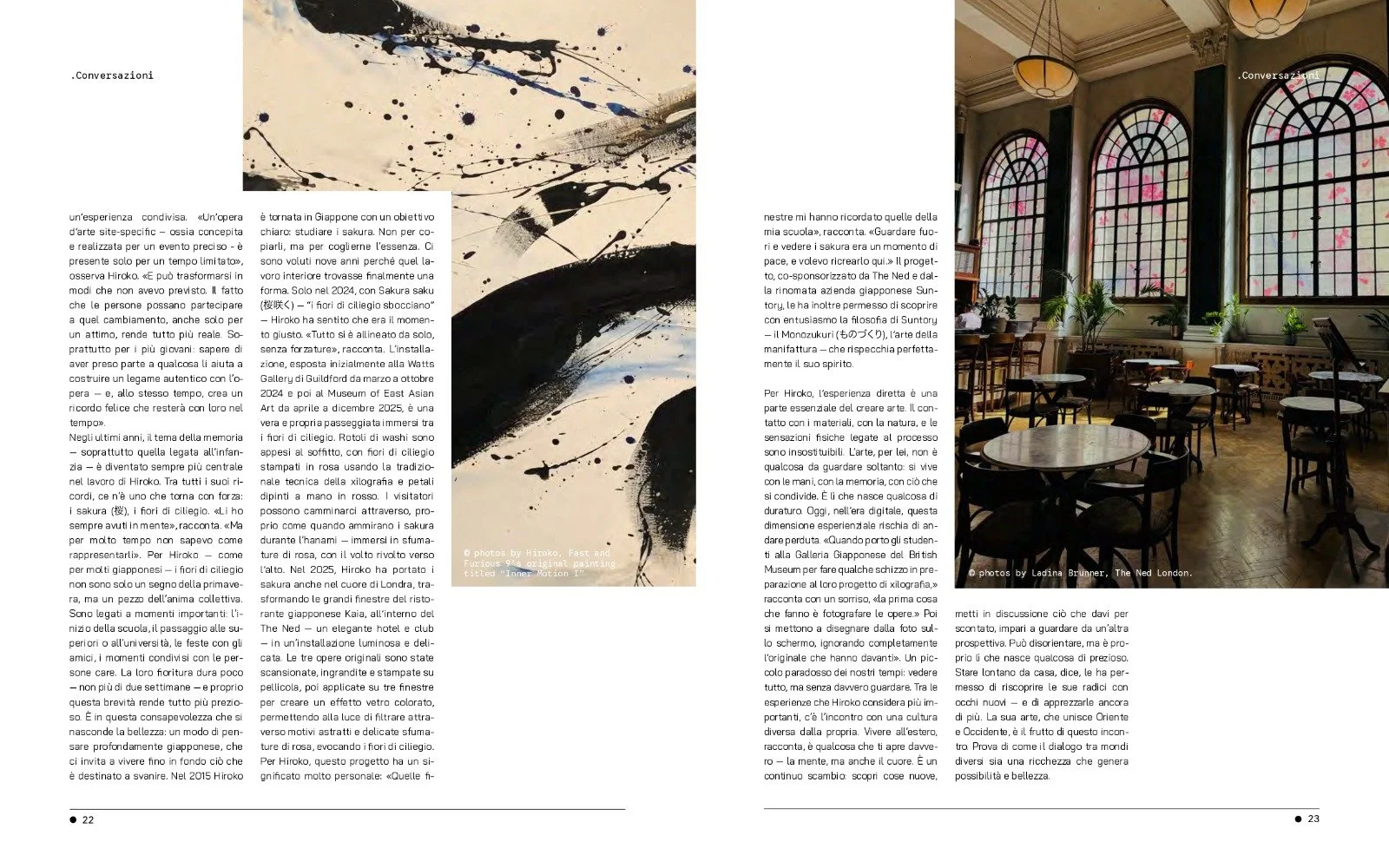
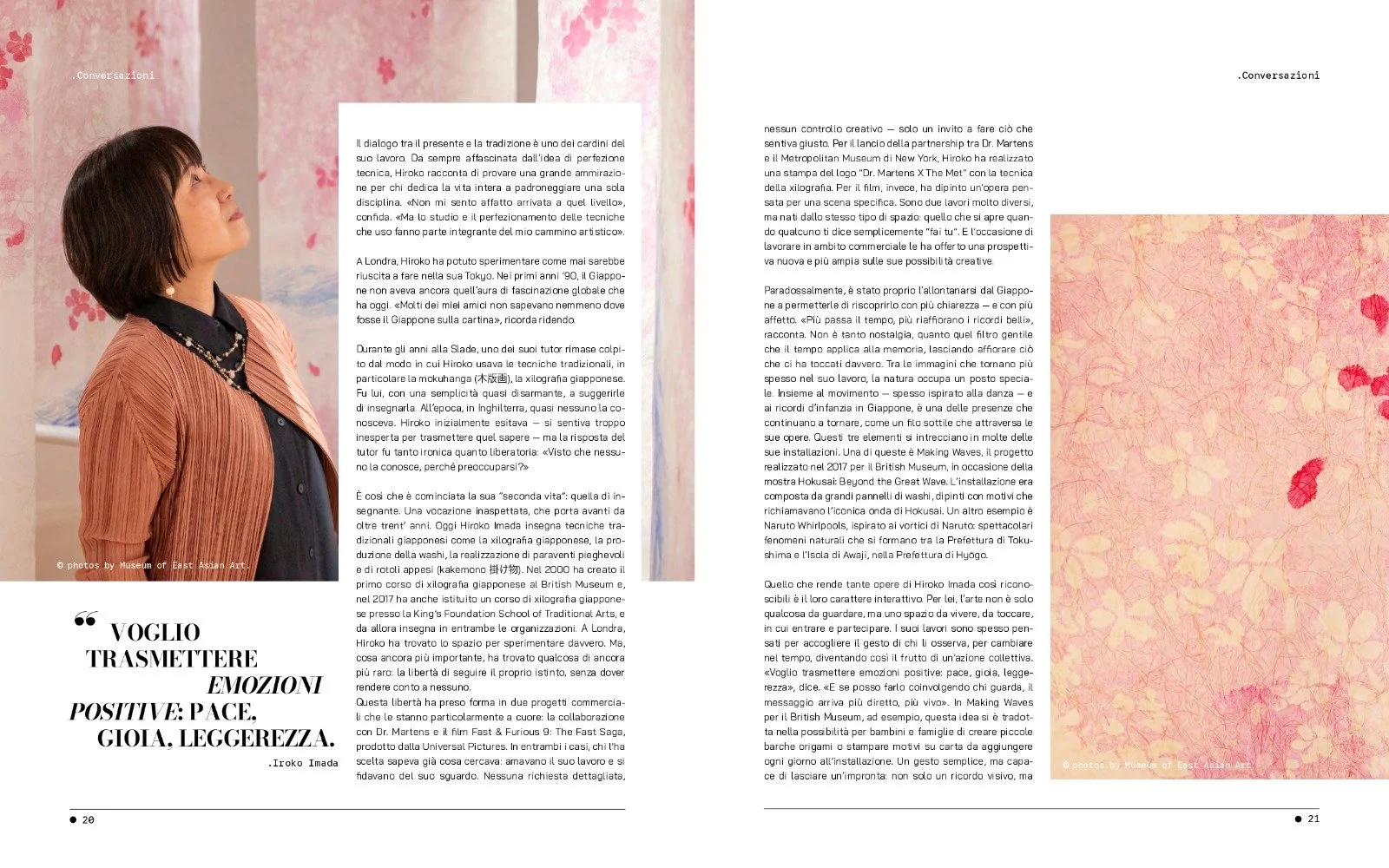
HIROKO IMADA: BETWEEN TWO WORLDS (English Translation)
Japanese tradition and creative freedom in the life of an artist in dialogue with two cultures.
There is something hypnotic in the gestures of those who make paper by hand. A slow rhythm, made of water, plant fibers, and patience. This is where the journey of Hiroko Imada begins — an artist born in Tokyo and now based in London — who has made washi (和紙), the traditional Japanese paper, the core of her artistic exploration.
During her studies at Tokyo Zokei University, Hiroko delved into the techniques of papermaking, developing from the very beginning a distinct sensitivity to the material: its textures, transparency, and structure. This attention to detail continued to grow at the Slade School of Fine Art in London, where, in 1992, her graduation show caught the eye of The Times critic David Cohen, who described it as “the announcement of a new, impressive talent.”
Moving to the UK was not a random choice. While studying in Tokyo, Hiroko felt that the Japanese art scene was a bit too limiting. “I was fascinated by the technique, by its depth, but I lacked the space to truly make it my own,” Hiroko recalls. At the time, art in Japan seemed divided into rigid compartments: on one side, tradition; on the other, the avant-garde. But she wanted to experiment, starting precisely from that ancient material — and she couldn’t find enough room to do so there.
London, on the other hand, was a completely different story. A city where contemporary art welcomed contamination, hybridization, and experimentation. "I’ve always felt a certain affinity for England," she says. And it was right in the heart of this British metropolis that she found the freedom she needed to build her own path and shape a research that truly represented her.
The dialogue between the present and tradition is a cornerstone of her work. Always fascinated by the idea of technical perfection, Hiroko expresses deep admiration for those who dedicate their entire lives to mastering a single discipline. "I don’t feel anywhere near that level," she confides. "But studying and perfecting the techniques I use is an integral part of my artistic journey."
In London, Hiroko had the opportunity to experiment in ways she would never have been able to do in her native Tokyo. In the early 1990s, Japan hadn’t yet acquired the global fascination it holds today. "Many of my friends didn’t even know where Japan was on the map," she recalls, laughing.
During her years at Slade, one of her tutors was struck by the way Hiroko used traditional techniques, particularly mokuhanga (木版画), Japanese woodblock printing. With almost disarming simplicity, he suggested she teach it. At the time, almost no one in England knew about it. Hiroko initially hesitated — she felt too inexperienced to pass on that knowledge — but the tutor’s response was as ironic as it was liberating: "Since no one knows it, why worry?"
This is how her "second life" began: as a teacher. An unexpected vocation she’s pursued for over thirty years. Today, Hiroko Imada teaches traditional Japanese techniques such as Japanese woodblock printing, washi-making, and the creation of folding screens and hanging scrolls (kakemono 掛け物). In 2000, she established the first Japanese woodblock printing course at the British Museum, and in 2017, she has also established a Japanese woodblock printing course at the King’s Foundation School of Traditional Arts and has been teaching both organizations since then. In London, Hiroko found the space to truly experiment. But more importantly, she found something even rarer: the freedom to follow her instincts, without having to answer to anyone.
This freedom took shape in two commercial projects she holds particularly dear: the collaboration with Dr. Martens and the Universal Pictures film Fast & Furious 9: The Fast Saga. In both cases, those who chose her already knew what they were looking for: they loved her work and trusted her perspective. No detailed requests, no creative control — just an invitation to do what felt right. For the launch of the Dr. Martens x The Metropolitan Museum of New York partnership, Hiroko made a print of the "Dr. Martens X The Met" logo using woodblock printing technique. For the film, she painted a piece for a specific scene. Two very different works, but both born from the same kind of space: the one that opens up when someone simply says, "You do it." And the opportunity to work in a commercial context gave her a new and broader perspective on her creative possibilities.
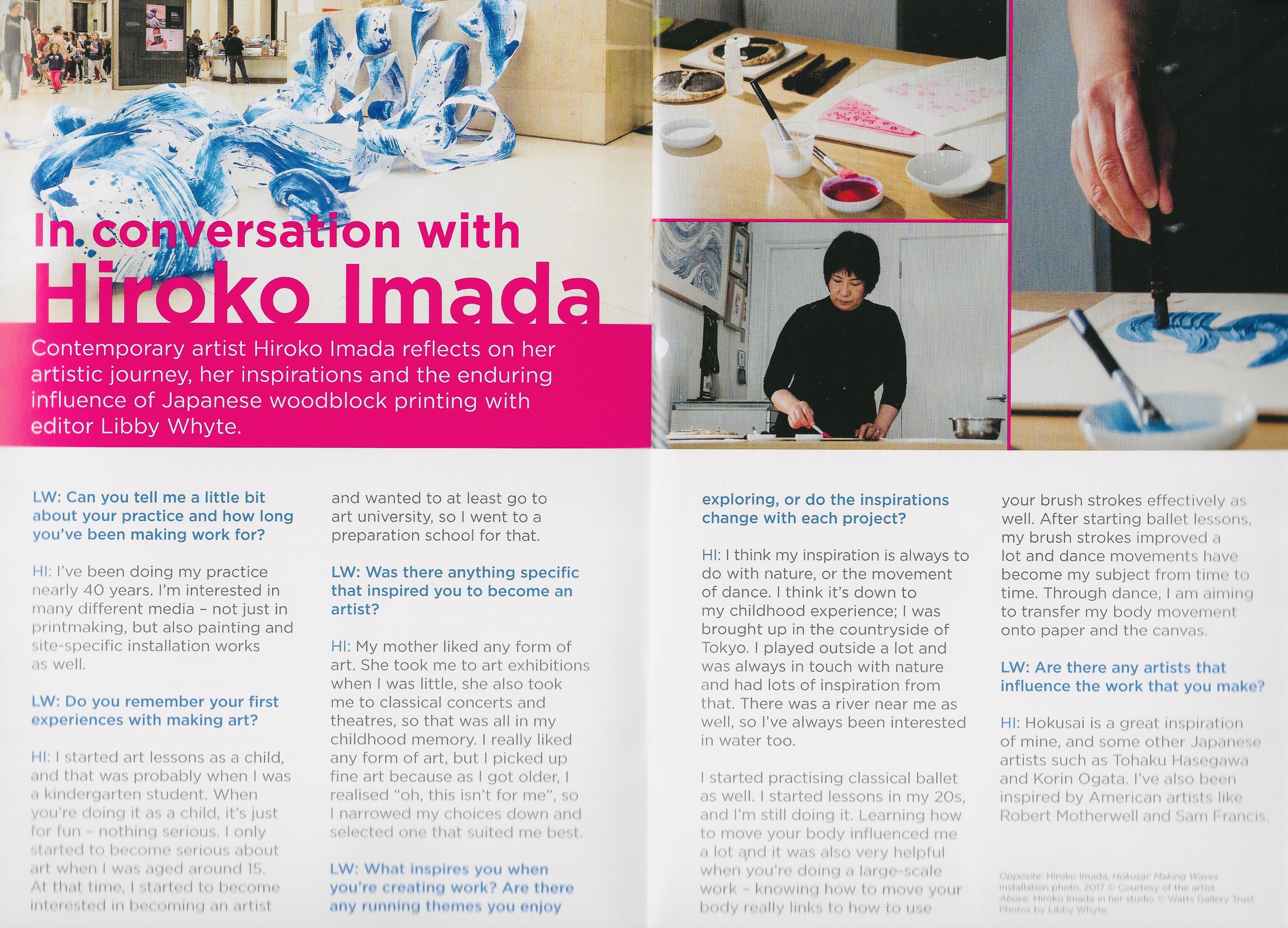
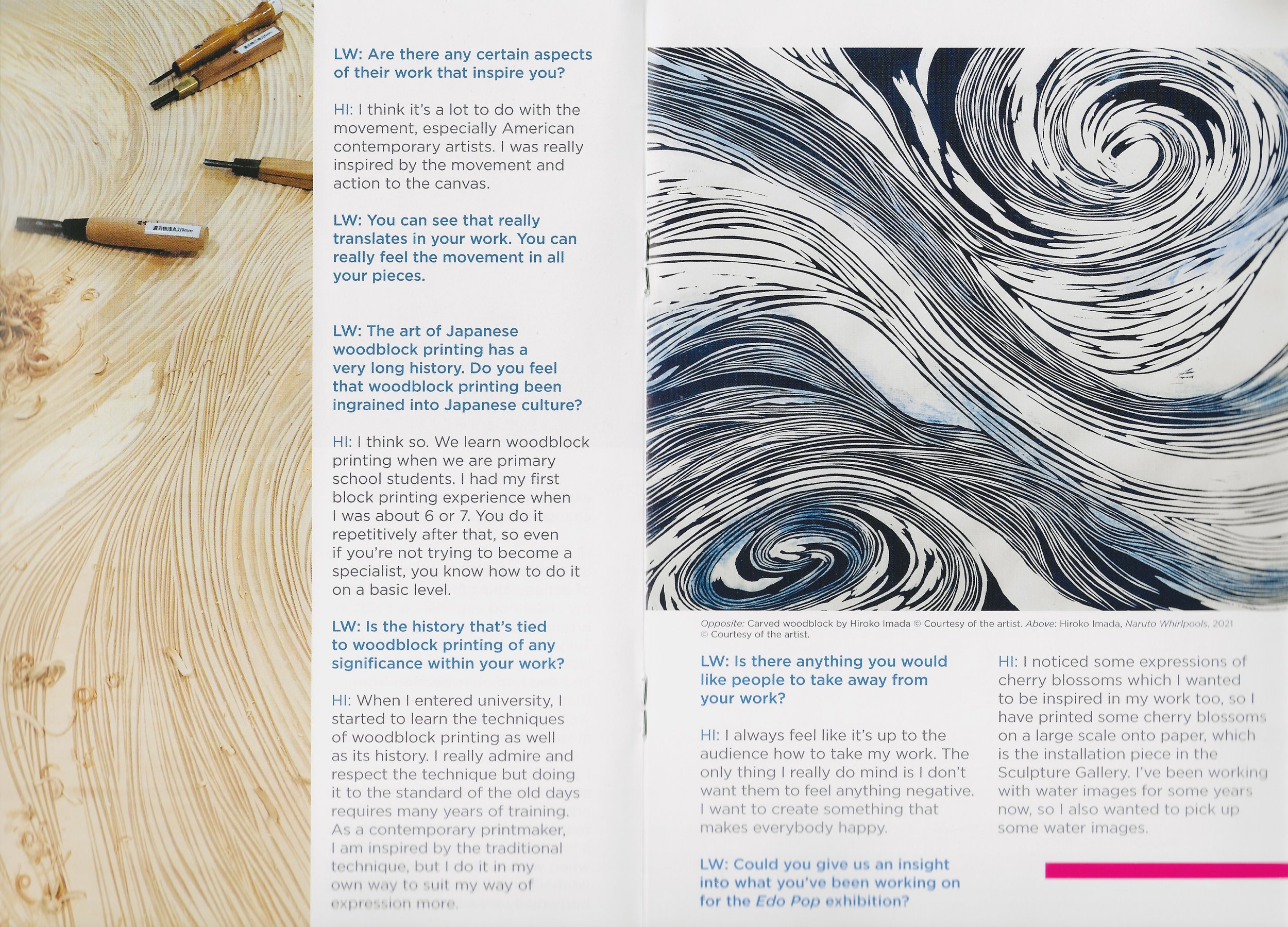
Ironically, it was leaving Japan that allowed her to rediscover it more clearly — and with greater affection. "The more time passes, the more the beautiful memories resurface," she says. It’s not so much nostalgia, but rather that gentle filter time applies to memory, bringing forward what really touched us. Among the images that most often return in her work, nature holds a special place. Along with movement — often inspired by dance — and childhood memories in Japan, it’s one of the recurring presences, like a thin thread running through her pieces. These three elements intertwine in many of her installations. One of them is Making Waves, a 2017 project created for the British Museum as part of the exhibition Hokusai: Beyond the Great Wave. The installation consisted of large panels of washi, painted with motifs referencing Hokusai’s iconic wave. Another example is Naruto Whirlpools, inspired by the whirlpools of Naruto: spectacular natural phenomena that form between Tokushima Prefecture and Awaji Island in Hyogo Prefecture.
What makes many of Hiroko Imada’s works so recognizable is their interactive character. For her, art isn’t just something to look at, but a space to live in, to touch, to enter, and participate in. Her works are often designed to welcome the gesture of those who observe them, to change over time, becoming the result of a collective action. "I want to convey positive emotions: peace, joy, lightness," she says. "And if I can do that by involving the viewer, the message reaches them more directly, more vividly." In Making Waves at the British Museum, for example, this idea translated into the possibility for children and families to create small origami boats or print patterns on paper to add to the installation each day. A simple gesture, but one capable of leaving an imprint: not just a visual memory, but a shared experience. "A site-specific artwork exists only for a limited time," Hiroko observes. "And it can transform in ways I hadn’t anticipated. The fact that people can participate in that change, even if only for a moment, makes everything feel more real. Especially for the younger ones: knowing they’ve taken part in something helps them build an authentic connection with the work — and at the same time, it creates a happy memory that will stay with them for a long time."
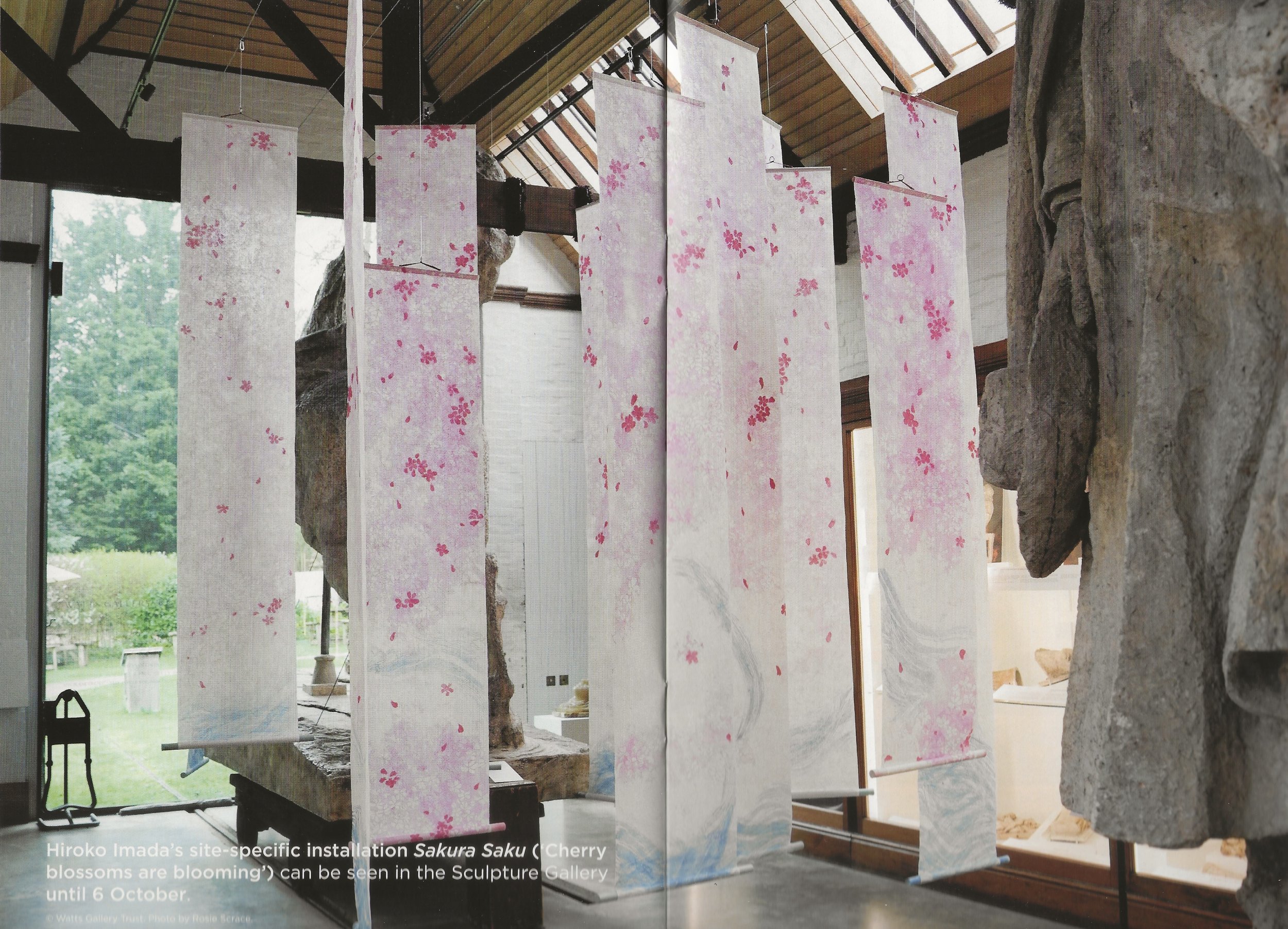
In recent years, the theme of memory — especially childhood memory — has become increasingly central in Hiroko’s work. Among all her memories, one in particular resurfaces strongly: the sakura (桜), cherry blossoms. "I’ve always had them in mind," she says. "But for a long time, I didn’t know how to represent them." For Hiroko — as for many Japanese people — cherry blossoms are not just a sign of spring, but a piece of the collective soul. They’re tied to important moments: the start of school, the transition to high school or university, parties with friends, moments shared with loved ones. Their bloom lasts only a short time — no more than two weeks — and this brevity makes it all the more precious. It is in this awareness that beauty lies: a deeply Japanese way of thinking, which invites us to live fully what is destined to fade. In 2015, Hiroko returned to Japan with a clear goal: to study the sakura. Not to copy them immediately, but to capture their essence. It took nine years for that inner work to finally take shape. Only in 2024, with Sakura Saku (桜咲く) — "The cherry blossoms are blooming" — did she feel that the time had come. "Everything aligned on its own, without forcing it," she says. The installation, exhibited at first at Watts Gallery in Guilford from March to October 2024 then at the Museum of East Asian Art from April to December 2025, is a true walk immersed in the blossoms. Washi scrolls hang from the ceiling, printed cherry blossoms in pink using traditional woodblock printing and hand-painted petals in red. Visitors can walk through them, just like when they go to admire the sakura during hanami — immersed in shades of pink, with their faces turned upwards.
In 2025, Hiroko brought sakura to the heart of London, transforming the large windows of the Japanese restaurant Kaia, inside The Ned — an elegant hotel and club — into a delicate, luminous installation. The original 3 art works scanned, enlarged and printed on film then attached onto 3 windows to create a stained-glass effect, allowing light to filter through abstract patterns and soft pink hues, evoking the cherry blossoms. For Hiroko, this project holds a very personal meaning: "Those windows reminded me of the ones in my school," she says. "Looking outside and seeing the sakura was a moment of peace, and I wanted to recreate that here." This project co-sponsored by The Ned and Japanese renown company Suntory and she was excited to discover Suntory’s philosophy – Monozukuri (ものづくり) craftsmanship as it matches with her spirit.
For Hiroko, direct experience is an essential part of creating art. The contact with materials, nature, and the physical sensations tied to the process are irreplaceable. Art, for her, is not just to be looked at: it is lived with hands, with memory, with what is shared. That’s where something lasting is born. Today, in the digital age, this experiential dimension risks being lost. "When I take students to the Japanese Gallery at the British Museum to do some sketches for their woodblock design," she says with a smile, "the first thing they do is photograph them. Then they start drawing from the photo on the screen, completely ignoring the original right in front of them." A small paradox of our times: seeing everything, but not truly looking.
One of the most important experiences Hiroko values is the encounter with a culture different from her own. Living abroad, she says, is something that truly opens you up — both your mind and your heart. It’s an ongoing exchange: you discover new things, question what you once took for granted, learn to see from a new perspective. It can be disorienting, but that’s where something precious is born. Being away from home, she says, allowed her to rediscover her roots with new eyes — and appreciate them even more. Her work, which unites East and West, is the result of this encounter. Proof that the dialogue between different worlds is a richness that generates possibilities and beauty.
27 September 2024: UCL News
Blossoms of Tradition and Modernity: Hiroko Imada at the Watts Gallery
UCL VPEE Student Journalism Scheme student Caroline Coyer visits the Edo Pop: Japanese Prints 1825-1895 exhibition at Watts Gallery to explore the work of Slade alumna Hiroko Imada.
21 June 2024: Watts Gallery website Blog, In conversation with Hiroko Imada
https://www.wattsgallery.org.uk/blog/in-conversation-with-hiroko-imada
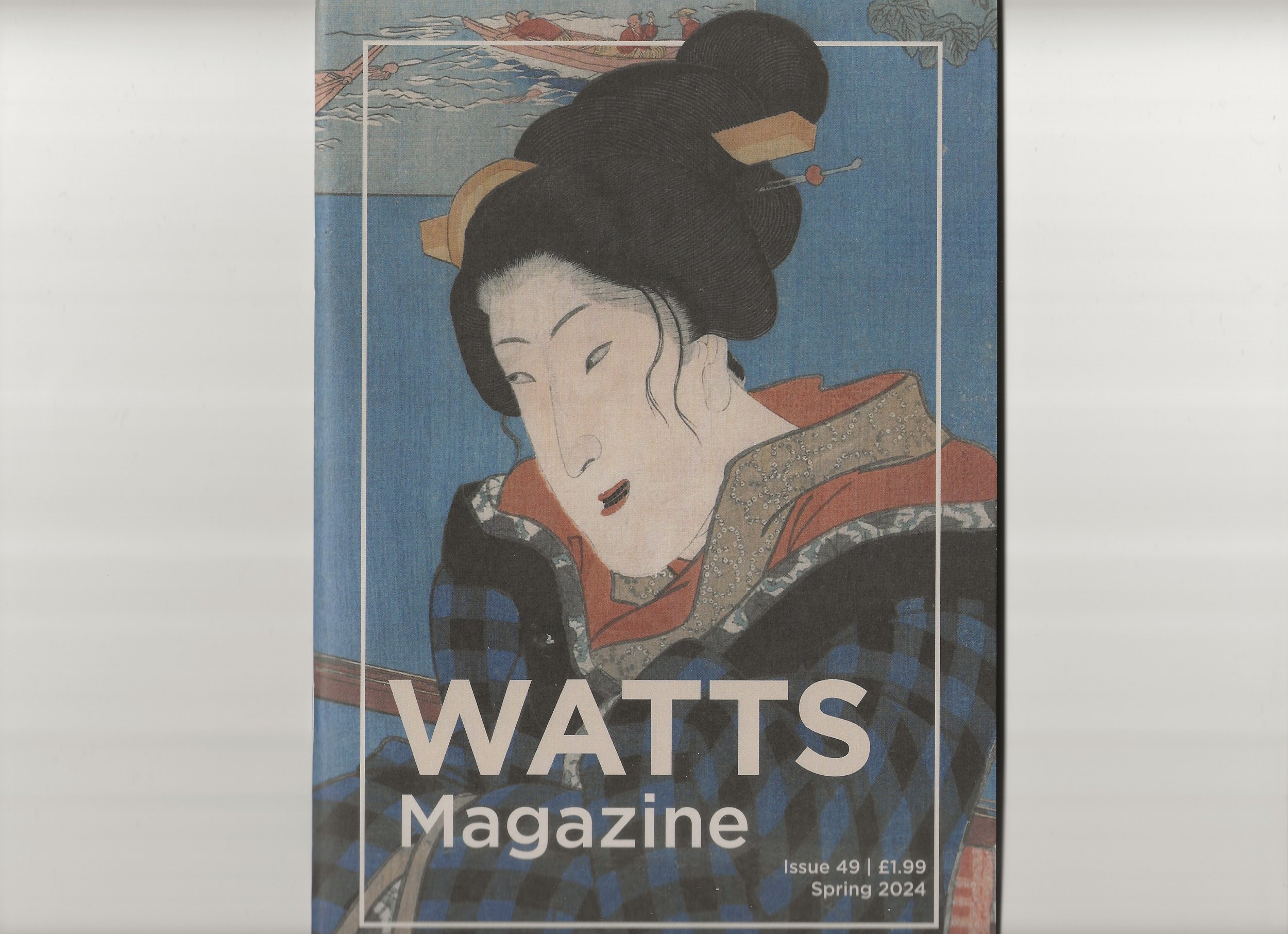
2024 Spring: Watts Magazine, Issue 49, In conversation with Hiroko Imada
2023 April: Chief of Stuff Magazine, Issue 4, One to One: Hiroko Imada


